
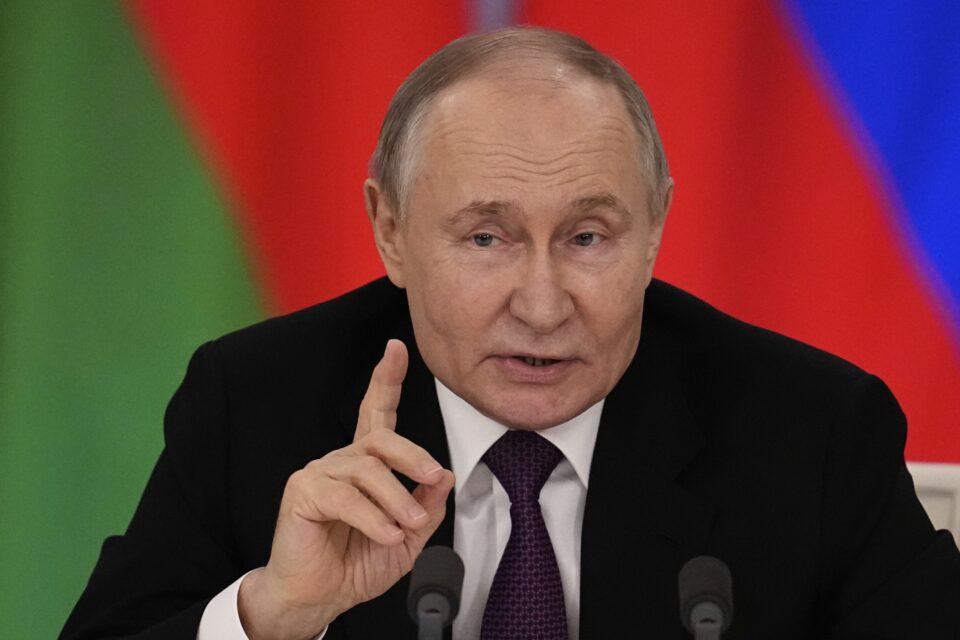
While outlining several difficult requirements for peace, Vladimir Putin has stated that while he supports the idea of a ceasefire in Ukraine, “questions” still surround the specifics of the truce.
Following discussions with the United States earlier this week, Ukraine agreed to a 30-day ceasefire plan, to which the Russian president was reacting.
US President Donald Trump’s special envoy Steve Witkoff, who had flown to Moscow earlier that day, was scheduled to meet with Putin on Thursday night to discuss the ceasefire, according to Russian officials.
Putin’s reaction to the plan was deemed “manipulative” by Ukrainian President Volodymyr Zelensky, who also demanded additional sanctions against Russia.
In the meantime, the US imposed additional sanctions on the banking, gas, and oil industries in Russia.
Whether or not that meeting actually happened is unclear. The plane thought to be carrying Witkoff has departed Moscow, according to Flightradar, an air traffic monitor cited by Russia’s state media on Friday.
Washington and Moscow have refrained from commenting on the matter.
Is Putin stalling or is he prepared for a ceasefire?
Russia and Ukraine both reported fresh enemy drone attacks late Thursday and overnight.
Ukraine reported that seven people, including children, were hurt in Kharkiv, a city in the northeast.
In the southern city of Tuapse, Russia reported a large fire at an oil facility.
Regarding the ceasefire proposal, Putin stated during a press conference in Moscow on Thursday: “The idea is right – and we support it – but there are questions that we need to discuss.”
According to Putin, “an enduring peace and remove the root causes of this crisis” should result from a ceasefire.
He stated, “We must engage in negotiations with our American partners and colleagues.” “I might give Donald Trump a call.”
Putin went on: “A 30-day ceasefire will benefit the Ukrainian side.
“There are nuances, but we are in favor of it.”
According to Putin, one of the points of contention is the Kursk region in western Russia, where Ukraine launched a military invasion in August of last year and took some territory.
He asserted that Ukrainian forces in Kursk “have been isolated” and that Russia had regained complete control of the city.
“We are in charge, but they are attempting to flee. “They have abandoned their equipment,” Putin declared.
“The Ukrainians in Kursk have two choices: give up or perish.”
A day earlier, Ukrainian troops would maintain defensive positions in the Kursk region “as long as it is expedient and necessary” in spite of “increased” pressure from Russian forces, according to statements made by Oleksandr Syrskyi, Ukraine’s top commander.
Putin also listed some of his concerns about the operation of a ceasefire during the press conference on Thursday. “How will those 30 days be used?” he inquired. For Ukraine to organize? Rearm? Educate others? Or none of it? Then comes the question: how will that be managed?
“Who is going to order the fighting to stop? How much does it cost? Over 2,000 kilometers, who gets to decide who has violated any potential ceasefire? Both sides must carefully consider each of those questions. Who is in charge of it?
In his nightly video address, Zelensky stated that although Putin “doesn’t say no directly,” “in practice, he’s preparing a rejection.”
The positions of the two sides are now clearly separated in the wake of Putin’s comments and Zelensky’s response.
A brief ceasefire followed by discussions about a longer-term solution is what Ukraine wants from the process.
He went on to say: “Putin is obviously scared to tell President Trump directly that he wants to kill Ukrainians and continue this war.”
“That nothing will work out at all” was Zelensky’s assessment of the numerous prerequisites set by the Russian leader.
The positions of the two sides are now clearly separated in the wake of Putin’s comments and Zelensky’s response.
A brief ceasefire followed by discussions about a longer-term solution is what Ukraine wants from the process.
Russia feels that all issues should be resolved in a single agreement and that the two processes cannot be separated. It appears that both sides are happy to debate their differences.
Ukraine thinks it can exert pressure on Russia by portraying it as a reluctant mediator in order to buy time. Russia also thinks this is an opportunity to voice its basic concerns regarding Ukraine’s sovereignty and NATO expansion.
However, this poses a challenge for Donald Trump. He has made it apparent that he wants the conflict to end quickly—within a few days.
Furthermore, Putin doesn’t seem to want to cooperate at the moment.
In a White House speech after Putin’s comments, Trump expressed his hope that Russia would “do the right thing” and accept the proposed 30-day truce, adding that he would “love” to meet the Russian leader.
He stated, “We’d like to see a ceasefire from Russia.”
Trump told reporters earlier that he had already discussed specifics with Ukraine during a meeting with NATO Secretary General Mark Rutte in the Oval Office.
Trump stated that he and Ukraine have been talking about “land and pieces of land that would be kept and lost, and all of the other elements of a final agreement.”
“In fact, many of the specifics of a final agreement have been discussed.”
Trump stated that “everybody knows what the answer to that is” in reference to Ukraine joining the NATO military alliance.
As the Trump administration further limited access to US payment systems, making it more difficult for other nations to purchase Russian oil, new sanctions were imposed on Russian gas and oil.
Yuri Ushakov, a Kremlin aide, had earlier in the day rejected the US ceasefire proposal.
A video purportedly showing Putin visiting Russia’s Kursk region while wearing military fatigues was released by the Kremlin on Wednesday. Later, Russia claimed to have retaken the important town of Sudzha.
About 20% of Ukrainian territory is currently under Russian control after a full-scale invasion in February 2022.
According to data analyzed thus far and verified by the BBC, over 95,000 Russian military personnel have lost their lives in the conflict. It is thought that the true death toll is significantly higher.
Since September 2022, when it claimed 5,937 soldiers had been killed, Russia’s military has not made its battlefield casualties publicly available.
Zelensky acknowledged 43,000 Ukrainian deaths among soldiers and officers in December 2024, the last time Ukraine updated its casualty figures. According to Western analysts, this number is understated.
